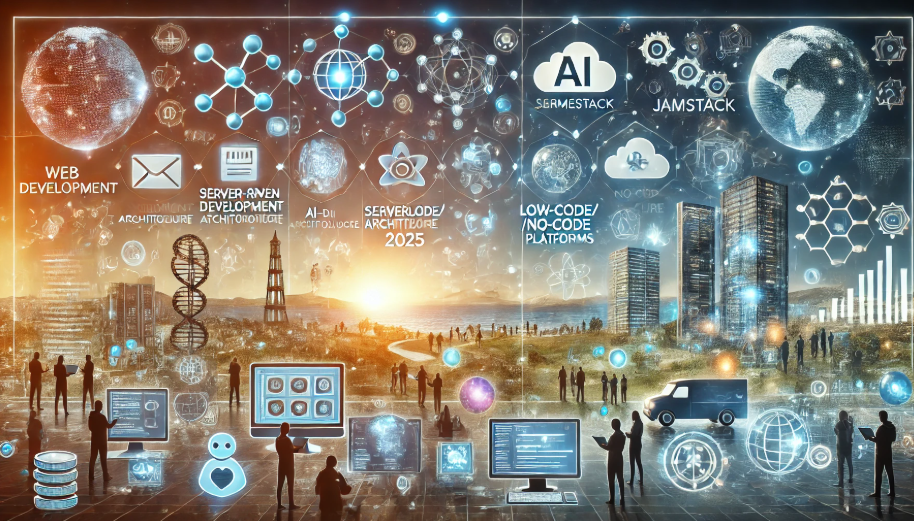
7 Web Development Trends Every Developer Must Learn in 2025
Introduction
The web development landscape is evolving at lightning speed, with new technologies and approaches reshaping how we build, deploy, and maintain web applications. As we head into 2025, staying ahead of these changes is no longer just a good-to-have skill; it’s an absolute necessity for developers aiming to stay competitive and relevant. Whether you are a front-end specialist focusing on user interfaces, a back-end engineer building robust server-side logic, or a full-stack developer working across both spectrums, understanding these trends can significantly enhance your projects and career trajectory. In this blog, we will take a comprehensive look at the top 7 web development trends of 2025 that are influencing the industry and how you can leverage them.
1. AI-Driven Development
Artificial Intelligence (AI) is rapidly embedding itself into web development workflows. Tools like GitHub Copilot, Tabnine, and AI-based testing frameworks are transforming how developers write, debug, and optimize code. AI is not just about automation anymore—it is about enhancing developer productivity, personalizing user experiences through AI-driven chatbots, and enabling smarter decision-making processes with predictive analytics.
In 2025, AI will become more proactive, recommending design patterns, generating boilerplate code, and even predicting potential bugs before deployment. Moreover, AI-powered personalization engines will help tailor user interfaces to individual user behaviors, increasing conversion rates and engagement.
Impact: Shortened development lifecycles, data-driven user interfaces, and increased productivity through intelligent automation.
2. Headless CMS & JAMstack Architecture
The demand for faster, more secure, and scalable websites is pushing developers toward Headless CMS and JAMstack architecture. Unlike traditional CMS platforms, headless solutions like Contentful, Strapi, and Sanity provide content via APIs, decoupling the back-end from the front-end entirely.
By integrating this with JAMstack principles (JavaScript, APIs, Markup), developers can create lightning-fast static websites that scale effortlessly and offer unparalleled performance. Combined with tools like Next.js, Astro, and Netlify Edge Functions, JAMstack-based applications are becoming the new standard in web performance and security.
Popular Tools: Contentful, Strapi, Sanity, Next.js, Astro, Netlify.
Impact: Faster page loads, better SEO, greater flexibility for omnichannel delivery, and improved security posture.
3. Progressive Web Apps (PWAs) 2.0
PWAs are undergoing a significant evolution in 2025. Modern PWAs provide native app-like performance and reliability, even in offline or low-connectivity environments. Enhanced with capabilities like background sync, push notifications, app-like navigation, and device hardware access (e.g., camera, GPS), PWAs are now a powerful tool for businesses aiming to deliver seamless user experiences.
Big brands such as Uber, Spotify, and Starbucks are increasingly turning to PWAs to serve global audiences with varied internet connectivity, reducing friction in user journeys and optimizing mobile web performance.
Impact: Improved accessibility, reduced bounce rates, greater reach in emerging markets, and app-like experiences on the web.
4. Low-Code/No-Code Platforms
Low-code and no-code development platforms are breaking barriers, allowing startups and enterprises to create functional applications faster than ever. Tools like Webflow, Bubble, and OutSystems are empowering non-developers (citizen developers) to bring ideas to life without writing extensive code, while developers are using these platforms to accelerate prototyping and validate concepts quickly.
In 2025, these platforms will continue integrating with AI and automation tools, further reducing development time. Developers can focus more on custom logic, integrations, and solving complex problems while offloading repetitive UI and backend tasks to these platforms.
Popular Platforms: Webflow, Bubble, OutSystems, Mendix.
Impact: Faster MVP and product launches, significant reduction in development costs, and broader access to app-building capabilities.
5. Serverless Architecture
Serverless computing is revolutionizing web app deployment by eliminating the need for developers to manage server infrastructure. Cloud providers such as AWS Lambda, Google Cloud Functions, and Azure Functions offer auto-scaling, pay-as-you-go models, and simplified deployment processes.
Beyond just backend services, serverless architecture is being extended to databases (e.g., Firebase Firestore), authentication (e.g., Auth0), and file storage (e.g., Amazon S3). This shift enables leaner DevOps workflows and allows developers to focus more on product features rather than infrastructure maintenance.
Impact: Cost optimization, improved scalability, faster development cycles, and enhanced DevOps agility.
6. Enhanced Web Security
With cyberattacks becoming more complex and frequent, security in web development has reached a critical juncture. In 2025, security-first development is a must. Techniques such as Zero Trust Architecture (ZTA), multi-factor authentication (MFA), end-to-end encryption, and real-time threat detection using AI will be standard.
Developers are increasingly integrating Content Security Policies (CSP), HTTP security headers, and leveraging tools like Snyk and OWASP ZAP to detect and fix vulnerabilities early. Regulatory compliance (GDPR, CCPA) and industry standards (ISO/IEC 27001) are also driving security best practices.
Impact: Enhanced user trust, reduced data breaches, and better compliance with global data protection regulations.
7. WebAssembly (WASM)
WebAssembly (WASM) is bridging the gap between web and native app performance. By allowing developers to run compiled code (C++, Rust, Go) directly in the browser, WASM makes it possible to build high-performance applications like 3D games, video editors, and scientific simulations that were traditionally limited to desktop environments.
In 2025, WASM is finding broader applications in areas such as blockchain, augmented reality (AR), virtual reality (VR), and AI-powered web tools. WASM modules can work alongside JavaScript, offering hybrid applications that combine performance and flexibility.
Impact: Near-native speed in browsers, reduced memory usage, and the capability to build next-gen, resource-intensive web apps.
Conclusion
The future of web development is full of transformative opportunities. From AI automation to serverless architectures and beyond, the trends of 2025 are equipping developers with the tools needed to create cutting-edge, high-performing, and secure web applications. Embracing these advancements will not only boost your productivity but also future-proof your skills in a competitive industry.
Staying ahead of the curve by learning and implementing these trends will position you as a sought-after developer capable of delivering innovative solutions for the modern web.
Which of these trends do you plan to adopt in your next project? Share your thoughts and experiences in the comments below!
FAQs
Q1: Which web development trend is most beginner-friendly in 2025?
A: Low-code/no-code platforms are ideal for beginners as they offer drag-and-drop interfaces and pre-built components, making it easy to build applications with minimal coding.
Q2: Will AI replace human web developers entirely?
A: No, AI will serve as a powerful assistant that automates repetitive tasks, but creativity, critical thinking, and complex problem-solving will always require human intervention.
Q3: Is learning WebAssembly (WASM) essential for all developers?
A: While not mandatory for everyone, learning WASM is highly beneficial if you are working on performance-intensive web applications such as gaming engines, multimedia editors, or complex simulations.