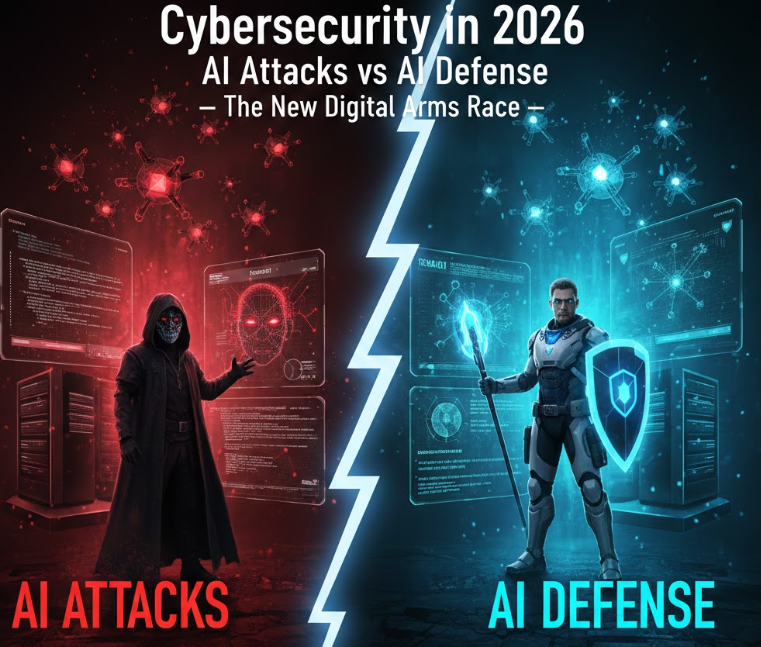
Cybersecurity in 2026: AI Attacks vs AI Defense — The New Digital Arms Race
As 2025 closed and 2026 began, one message from end-of-year security reports was unmistakable: artificial intelligence has permanently changed cybersecurity. Attackers are now using AI to automate phishing, generate malware variants at scale, and probe defenses faster than ever. At the same time, defenders are deploying AI to detect anomalies, respond in real time, and reduce human error.
This is no longer a cat-and-mouse game — it’s a machine-vs-machine arms race.
In this blog, we’ll explore what changed in December, why 2026 marks a turning point, and how organizations can adapt using AI defense, Zero Trust, and DevSecOps best practices.
Why December 2025 Was a Cybersecurity Wake-Up Call
December traditionally brings annual threat reports, and the latest ones confirmed a worrying trend:
AI-powered phishing campaigns surged in volume and quality
Malware became more adaptive and polymorphic
Human-written exploits were no longer the bottleneck — automation was
Security teams realized that manual rules and signature-based systems are no longer enough. Attackers can now generate thousands of attack variants in minutes, while defenders must protect sprawling cloud and SaaS environments.
AI-Powered Attacks: What Changed in 2026
AI-Generated Phishing Is Nearly Indistinguishable
Traditional phishing relied on poor grammar and generic messages. AI changed that completely.
Modern AI phishing campaigns can:
Personalize emails using scraped public data
Match company tone and branding
Generate multilingual messages instantly
Adapt content based on user responses
Impact: Even trained employees struggle to detect these attacks, dramatically increasing click-through rates.
Malware That Learns and Evolves
AI is being used to create self-modifying malware that:
Changes signatures to evade detection
Delays execution to bypass sandboxes
Selects exploits based on target environment
Instead of one static payload, attackers now deploy families of intelligent variants.
Automated Vulnerability Discovery
AI tools can scan:
Open-source repositories
API schemas
Cloud configurations
They identify weak points faster than human researchers, making time-to-exploit dangerously short after a vulnerability is disclosed.
🛡️ AI-Driven Defense: Fighting Fire with Fire
The good news? Defenders are also using AI — and doing it effectively.
🧩 Behavioral Threat Detection
Modern AI security systems no longer rely on known signatures. Instead, they analyze:
User behavior
Network traffic patterns
Process execution flows
This allows detection of unknown and zero-day attacks based on abnormal behavior rather than known malware fingerprints.
Real-Time Automated Response
AI-powered security platforms can now:
Quarantine compromised endpoints
Revoke credentials instantly
Isolate workloads in seconds
Trigger incident workflows automatically
Why it matters: In 2026, response speed matters more than perfect prevention.
🔍 Predictive Risk Analysis
AI models analyze historical incidents and system changes to:
Predict likely attack paths
Flag risky deployments
Recommend preventive controls
Security becomes proactive, not reactive.
Zero Trust in 2026: No Assumptions, Ever
The old “trusted internal network” model is officially obsolete.
What Zero Trust Means Now
Zero Trust in 2026 focuses on:
Continuous identity verification
Device health checks
Context-aware access decisions
Micro-segmentation of services
AI enhances Zero Trust by:
Detecting compromised identities
Adjusting access dynamically
Spotting lateral movement early
Key principle: Never trust — always verify — continuously.
DevSecOps Best Practices for 2026
Security can no longer be a final checklist — it must be embedded everywhere.
AI-Enhanced Secure Pipelines
Modern DevSecOps pipelines now include:
AI-based code scanning
Dependency risk scoring
Infrastructure-as-Code security checks
Runtime vulnerability monitoring
AI reduces false positives and highlights what actually matters, helping developers fix issues faster.
Shift-Left, But Smarter
Instead of overwhelming developers with warnings:
AI prioritizes exploitable risks
Security feedback is contextual
Fix recommendations are automated
Security becomes developer-friendly, not developer-blocking.
Humans Still Matter (More Than Ever)
Despite AI’s power, humans remain essential:
Defining security policies
Making ethical decisions
Handling complex incident response
Understanding business risk trade-offs
In 2026, the best security teams are human-led and AI-powered.
What Organizations Should Do Now
To stay secure in 2026:
✔️ Adopt AI-driven threat detection
✔️ Implement Zero Trust architecture
✔️ Integrate security deeply into DevOps
✔️ Train teams against AI-powered phishing
✔️ Monitor behavior, not just signatures
Security is no longer a product — it’s a continuous, intelligent system.
Final Thoughts: The AI Security Arms Race Has Begun
Cybersecurity in 2026 is defined by speed, intelligence, and automation. Attackers are moving faster and smarter, but defenders now have equally powerful tools.
Organizations that cling to legacy security models will fall behind. Those that embrace AI defense, Zero Trust, and DevSecOps will not just survive — they’ll be resilient.
The future of cybersecurity isn’t human or AI.
It’s human + AI, working together.