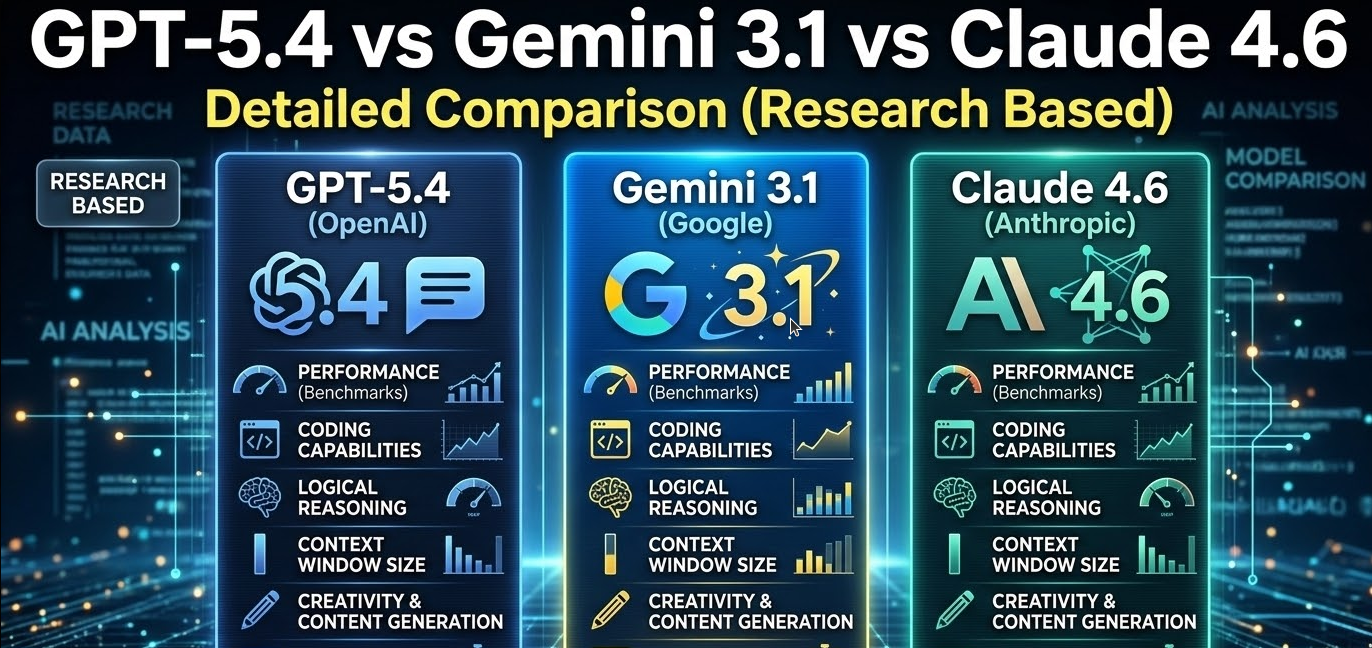
GPT‑5.4 vs Gemini 3.1 vs Claude 4.6 – Detailed Comparison (Research Based)
Introduction
Artificial Intelligence models are evolving rapidly. Many developers, businesses, and researchers are comparing modern large language models to decide which one best fits their needs. In this article we explore a research‑style comparison between GPT‑5.4, Gemini 3.1, and Claude 4.6. The goal of this article is educational: it summarizes publicly discussed capabilities, architecture ideas, and possible use cases.
This article does not make official or legal claims about these systems. Capabilities may change over time as providers update their models.
Overview of Modern AI Models
Modern large language models (LLMs) are trained on extremely large datasets and designed to perform tasks such as:
- Natural language understanding
- Code generation
- Research assistance
- Data analysis
- Image and multimodal processing
Three widely discussed AI systems in the industry are:
- GPT‑series models
- Gemini models
- Claude models
Each ecosystem focuses on slightly different strengths such as reasoning, multimodal capabilities, or safety design.
GPT‑5.4 Overview
GPT‑5.4 represents an advanced generation of transformer‑based AI models designed for reasoning, coding, and multimodal tasks. The GPT family is widely used by developers through APIs and integrated into many applications.
Possible strengths often discussed:
- Strong reasoning abilities
- Good performance in coding tasks
- Large context windows
- Broad ecosystem integration
Example usage:
A developer building a Laravel application might use GPT‑style models for:
- API documentation generation
- Code debugging
- Feature prototyping
Example prompt:
"Create a Laravel middleware that logs all API requests and responses."
The model could generate structured code and explanation.
Gemini 3.1 Overview
Gemini models are designed with a strong focus on multimodal AI capabilities. These systems often emphasize integration across text, images, video, and potentially other modalities.
Commonly discussed capabilities include:
- Multimodal understanding
- Integration with large cloud ecosystems
- Research and data analysis
Example usage:
A product team analyzing customer feedback might combine text analysis with image understanding.
Example prompt:
"Analyze customer reviews and summarize the most common product complaints."
Claude 4.6 Overview
Claude models are widely discussed for their focus on safety, reasoning clarity, and long‑context conversations. Many developers use them for long documents and structured reasoning tasks.
Potential strengths often highlighted:
- Long document analysis
- Safety focused design
- Structured explanations
Example usage:
A legal research assistant might analyze large PDF documents and generate summaries.
Example prompt:
"Summarize the key arguments from this 50‑page policy document."
Architecture Differences (High Level)
While exact architectures are not fully public, many modern AI models share some characteristics:
- Transformer based architecture
- Massive training datasets
- Reinforcement learning or alignment techniques
However, each company may implement variations in:
- training strategies
- mixture‑of‑experts architectures
- inference optimization
These differences can influence speed, reasoning capability, and cost.
Coding Performance Comparison
Developers often evaluate models based on coding performance.
Typical areas of comparison include:
- Code generation quality
- Bug detection
- Refactoring suggestions
- Framework knowledge
Example coding task:
"Build a REST API in Laravel that supports pagination and filtering."
Each model may generate a slightly different approach. Developers often compare:
- readability
- correctness
- security considerations
Reasoning and Research Tasks
For reasoning‑heavy tasks such as research summaries or step‑by‑step explanations, model behavior can differ.
Example task:
"Explain how distributed systems maintain consistency."
Some models might prioritize structured explanation, while others might provide more concise answers.
Multimodal Capabilities
Modern AI systems increasingly support multimodal inputs including:
- text
- images
- audio
- video
Multimodal capabilities enable use cases such as:
- visual question answering
- document scanning
- design analysis
Context Window and Memory
Context window size determines how much information the model can process in a single request.
Large context windows allow:
- full codebase analysis
- long document summarization
- multi‑step reasoning across many messages
Safety and Alignment
AI providers often implement safety and alignment mechanisms to reduce harmful or misleading outputs.
Typical approaches include:
- policy filtering
- reinforcement learning with human feedback
- monitoring systems
Example Practical Comparison
Consider a real developer scenario.
Task:
"Create a Laravel system that schedules Zoom meetings and generates a unique meeting link."
Possible model outputs could include:
- database schema suggestions
- controller code
- API integration steps
Developers may evaluate which model produces the clearest and most production‑ready solution.
Performance Considerations
Important performance metrics when evaluating AI models include:
- latency
- cost per request
- throughput
- scalability
Organizations typically benchmark models internally to determine which works best for their workloads.
When to Use Each Model
While exact suitability varies by project, general patterns sometimes discussed include:
GPT models:
- coding
- automation
- developer tools
Gemini models:
- multimodal applications
- research tasks
Claude models:
- long document processing
- reasoning workflows
Limitations of AI Comparisons
Comparing AI models is complex because:
- models are frequently updated
- benchmarks may vary
- real‑world performance depends on prompts
Therefore comparisons should be treated as general observations rather than definitive rankings.
Future of AI Models
AI development is progressing quickly. Future models may include:
- stronger reasoning
- real‑time multimodal interaction
- improved reliability
Organizations will likely adopt hybrid approaches that combine multiple AI systems.
Conclusion
GPT‑5.4, Gemini 3.1, and Claude 4.6 represent different design philosophies within the modern AI ecosystem. Each system may offer unique advantages depending on the task, environment, and integration requirements.
Developers and companies should evaluate models based on their specific needs, testing them with real workloads before making decisions.
As AI continues evolving, the landscape of capabilities and performance will likely change significantly.