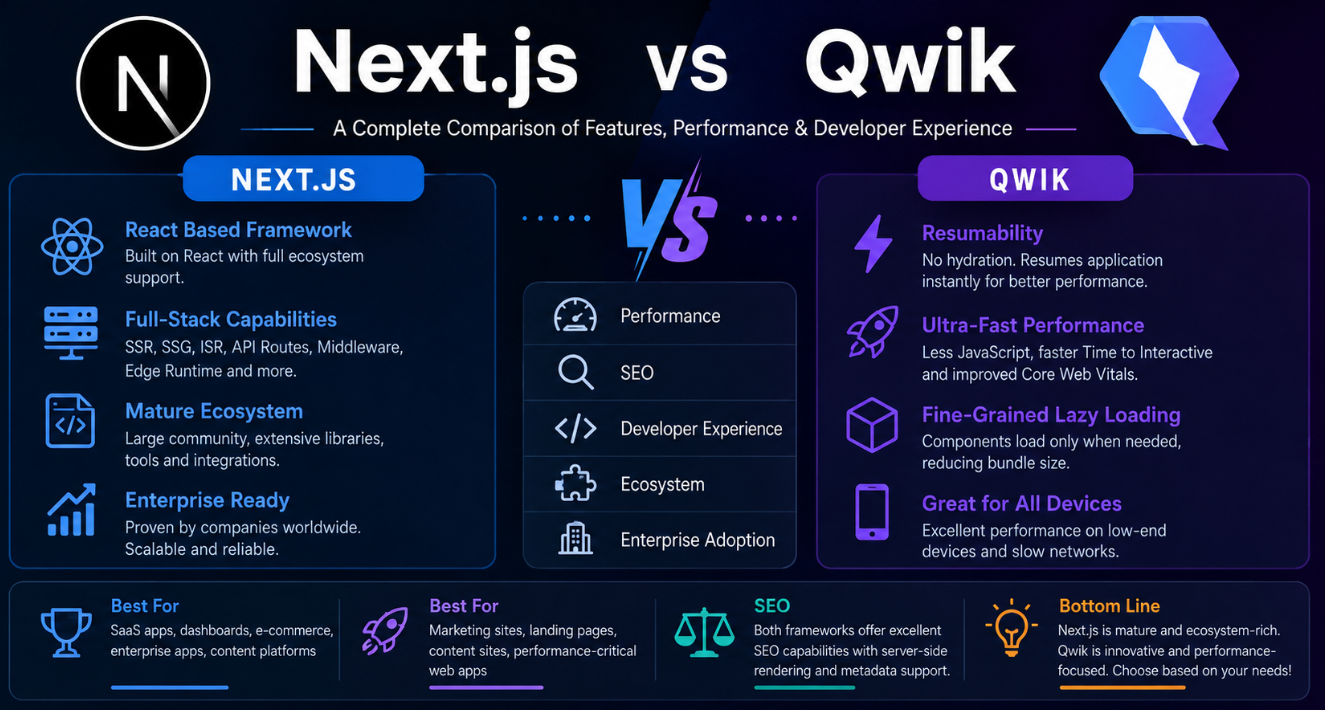
Next.js vs Qwik: Complete Comparison of Features, Advantages, Disadvantages, Performance, SEO, and Developer Experience
Introduction
Modern web applications demand fast performance, excellent user experiences, strong SEO capabilities, and efficient developer workflows. Among the many frameworks available today, Next.js and Qwik have gained significant attention for their unique approaches to building web applications.
Next.js has become one of the most widely adopted React frameworks, powering everything from personal blogs to enterprise-scale applications. Qwik, on the other hand, introduces an innovative resumability architecture designed to minimize JavaScript execution and improve page loading performance.
Both frameworks aim to deliver fast, scalable, and modern web experiences, but they achieve these goals using very different techniques.
In this article, we'll compare Next.js and Qwik in detail, examining their features, advantages, disadvantages, performance characteristics, SEO capabilities, developer experience, and ideal use cases.
What is Next.js?
Next.js is a React-based full-stack framework developed by the team behind Vercel.
It provides features such as:
- Server-Side Rendering (SSR)
- Static Site Generation (SSG)
- Incremental Static Regeneration (ISR)
- API Routes
- React Server Components
- Edge Runtime Support
- Image Optimization
- File-Based Routing
Next.js aims to simplify React application development while improving performance and SEO.
What is Qwik?
Qwik is a modern web framework created by Misko Hevery, one of the original creators of Angular.
Qwik introduces a concept called:
Resumability
Instead of hydrating an application after page load, Qwik resumes application state directly from the server-rendered HTML.
This approach reduces:
- JavaScript downloads
- Initial execution time
- Hydration costs
Qwik's primary focus is delivering instant-loading web applications.
Architecture Comparison
Next.js Architecture
Next.js follows a hydration-based architecture.
Process:
- Server renders HTML.
- Browser downloads JavaScript.
- React hydrates components.
- Event listeners attach.
- Application becomes interactive.
Advantages:
- Mature ecosystem
- Familiar React patterns
- Large community support
Challenges:
- Hydration cost increases with application size.
- More JavaScript execution on the client.
Qwik Architecture
Qwik uses resumability.
Process:
- Server renders HTML.
- Application state is serialized.
- Browser resumes execution when needed.
- Components load lazily.
Advantages:
- Less initial JavaScript.
- Faster startup.
- Better scalability for large applications.
Challenges:
- Different development mindset.
- Smaller ecosystem.
Feature Comparison
| Feature | Next.js | Qwik |
|---|---|---|
| React Based | Yes | No |
| SSR | Yes | Yes |
| SSG | Yes | Yes |
| Streaming | Yes | Yes |
| API Routes | Yes | Via integrations |
| Edge Runtime | Yes | Limited |
| Image Optimization | Built-in | Community solutions |
| Middleware | Yes | Available through adapters |
| React Ecosystem | Full Access | Not Compatible |
| Resumability | No | Yes |
| Hydration Required | Yes | No |
| Incremental Static Regeneration | Yes | Limited |
| Enterprise Adoption | High | Growing |
Performance Comparison
Initial Load Performance
Qwik's resumability architecture reduces the amount of JavaScript that must execute before interaction.
This can lead to:
- Faster Time to Interactive
- Lower CPU usage
- Improved startup performance
Particularly on:
- Low-end devices
- Slow networks
- Mobile users
Winner: Qwik
Navigation Performance
Next.js performs very well during client-side navigation.
React's ecosystem provides mature navigation handling.
Winner: Next.js
JavaScript Bundle Size
Qwik was designed to minimize JavaScript delivery.
Benefits:
- Smaller downloads
- Reduced parsing
- Reduced execution
Winner: Qwik
Large Enterprise Applications
Next.js offers mature tooling, integrations, and operational support.
Benefits:
- Large talent pool
- Extensive documentation
- Enterprise adoption
Winner: Next.js
SEO Comparison
Both frameworks support:
- Server rendering
- Meta tags
- Structured data
- Sitemap generation
- Open Graph tags
Search engines can effectively crawl applications built with either framework.
Winner: Tie
Developer Experience Comparison
Next.js Developer Experience
Advantages:
- React familiarity
- Massive community
- Extensive tutorials
- Rich ecosystem
- Excellent documentation
Developers experienced with React can become productive quickly.
Qwik Developer Experience
Advantages:
- Innovative architecture
- Performance-focused design
- Reduced hydration concerns
Challenges:
- Learning resumability concepts
- Smaller ecosystem
- Fewer third-party integrations
Advantages of Next.js
1. Massive Ecosystem
Developers gain access to:
- React libraries
- UI frameworks
- Authentication solutions
- State management tools
2. Enterprise Adoption
Many large organizations use Next.js.
Benefits include:
- Proven scalability
- Community support
- Long-term viability
3. Full-Stack Capabilities
Next.js supports:
- Frontend rendering
- Backend APIs
- Middleware
- Edge functions
from a single framework.
4. Excellent Documentation
Next.js provides extensive guides and examples.
Disadvantages of Next.js
Hydration Cost
Large applications may require substantial hydration work.
Larger JavaScript Payloads
Applications often send more JavaScript to browsers compared to resumable frameworks.
Performance Complexity
Optimization sometimes requires:
- Code splitting
- Dynamic imports
- Caching strategies
Advantages of Qwik
Resumability
One of Qwik's most innovative features.
Benefits:
- Faster startup
- Less JavaScript execution
- Improved responsiveness
Fine-Grained Lazy Loading
Components load only when needed.
Excellent Core Web Vitals Potential
Reduced JavaScript often improves:
- LCP
- INP
- TBT
metrics.
Mobile Performance
Qwik performs particularly well on slower devices.
Disadvantages of Qwik
Smaller Ecosystem
Compared to React and Next.js:
- Fewer libraries
- Fewer integrations
- Smaller community
Learning Curve
Developers must understand:
- Resumability
- Serialization boundaries
- Qwik-specific patterns
Fewer Enterprise Deployments
Qwik is newer and less widely adopted.
Organizations may require additional evaluation before adoption.
When Should You Choose Next.js?
Choose Next.js if:
- You already use React.
- You need enterprise-grade tooling.
- You require extensive integrations.
- Your team has React experience.
- You want a mature ecosystem.
Best for:
- SaaS platforms
- Enterprise applications
- E-commerce platforms
- Dashboards
- Content websites
When Should You Choose Qwik?
Choose Qwik if:
- Performance is your highest priority.
- Mobile users are critical.
- You want minimal JavaScript execution.
- You are building highly optimized web experiences.
Best for:
- Marketing websites
- Landing pages
- Content-heavy sites
- Performance-focused applications
]
Comparison Summary
| Category | Winner |
|---|---|
| Ecosystem | Next.js |
| Community | Next.js |
| Enterprise Adoption | Next.js |
| Learning Resources | Next.js |
| Initial Load Performance | Qwik |
| JavaScript Efficiency | Qwik |
| Mobile Performance | Qwik |
| React Compatibility | Next.js |
| Developer Hiring Availability | Next.js |
| Innovation | Qwik |
Final Verdict
Next.js and Qwik represent two different philosophies in modern web development.
Next.js focuses on providing a mature, full-featured framework built on React with extensive ecosystem support and enterprise readiness.
Qwik focuses on minimizing JavaScript execution through resumability, offering an innovative approach that can improve startup performance and user experience.
For most production teams, Next.js remains the safer and more established choice due to its ecosystem, community, and tooling.
For developers seeking cutting-edge performance optimization and willing to adopt a newer architecture, Qwik offers compelling advantages and introduces ideas that may influence the future of web development.
The right choice ultimately depends on your project's requirements, team expertise, performance goals, and long-term maintenance strategy.