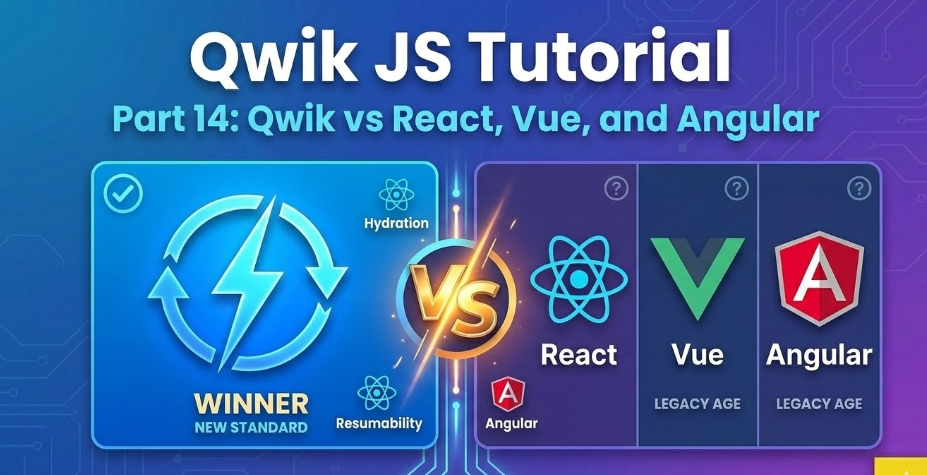
Qwik JS Tutorial – Part 14: Qwik vs React, Vue, and Angular
Introduction
Over the past decade, frontend development has been dominated by frameworks such as React, Vue, and Angular. These tools have enabled developers to build complex single-page applications and interactive web interfaces.
However, as applications became larger and more dynamic, developers also began encountering new challenges related to performance, bundle size, and the amount of JavaScript executed in the browser.
Qwik is a newer framework that introduces a different architectural approach focused on reducing the amount of JavaScript that must run during the initial page load. Instead of relying on traditional hydration techniques, Qwik introduces a concept known as resumability.
This article compares Qwik with React, Vue, and Angular to help developers understand their architectural differences, trade-offs, and typical use cases.
Understanding the Traditional Framework Model
Most popular JavaScript frameworks follow a similar execution pattern when rendering an application.
Typical Rendering Flow
- The server may render initial HTML.
- The browser downloads JavaScript bundles.
- The framework reconstructs the component tree.
- Event listeners are attached.
- The application becomes interactive.
This process is commonly known as hydration.
Hydration allows the browser to attach behavior to server-rendered HTML. While this approach works well for many applications, it can introduce additional JavaScript execution before the page becomes fully interactive.
Larger applications may involve larger bundles and longer hydration times, particularly on slower devices or networks.
Qwik’s Architectural Approach
Qwik approaches rendering differently.
Instead of executing the entire application in the browser during page load, Qwik serializes application state into HTML and resumes execution only when necessary.
This technique is known as resumability.
In a resumable application:
• The server renders the UI
• Application state is embedded into HTML
• JavaScript execution is deferred
• Code loads only when user interaction occurs
The goal is to minimize unnecessary work during initial load and allow the browser to execute JavaScript only when required.
React Overview
React is one of the most widely used frontend libraries for building user interfaces. It focuses on component-based architecture and uses a virtual DOM to manage updates efficiently.
React applications are typically built using tools such as Next.js, Vite, or Create React App.
Key Characteristics of React
Component-based UI development
Declarative rendering
Large ecosystem of libraries
Strong community support
Flexible architecture
Rendering in React
React commonly uses client-side rendering or server-side rendering followed by hydration.
In server-side rendered React applications, the server sends HTML first, and the client hydrates the application by executing JavaScript and attaching event listeners.
This approach allows React applications to support SEO and faster initial rendering while still enabling dynamic behavior.
Vue Overview
Vue is another popular JavaScript framework known for its approachable learning curve and progressive adoption model.
Vue allows developers to adopt it incrementally in existing projects or use it to build full single-page applications.
Key Characteristics of Vue
Reactive data system
Template-based syntax
Component architecture
Flexible integration options
Clear documentation
Rendering in Vue
Vue applications may use client-side rendering or server-side rendering depending on the architecture. Frameworks like Nuxt enable server-side rendering with hydration similar to React frameworks.
Vue’s reactivity system helps manage UI updates efficiently, but hydration still occurs when server-rendered applications become interactive.
Angular Overview
Angular is a full-featured frontend framework maintained by Google. Unlike React and Vue, Angular includes many features built directly into the framework.
These features include routing, dependency injection, form handling, and HTTP services.
Key Characteristics of Angular
Comprehensive framework structure
TypeScript-first development
Dependency injection system
Built-in tooling and CLI
Enterprise-oriented architecture
Rendering in Angular
Angular applications are typically compiled into JavaScript bundles that run in the browser. Server-side rendering can be implemented using Angular Universal, which renders HTML on the server and then hydrates the application on the client.
As with other frameworks, hydration is required before the page becomes fully interactive.
Comparing Qwik with React, Vue, and Angular
1. Rendering Strategy
React, Vue, and Angular generally rely on hydration to activate server-rendered content.
Qwik uses resumability instead of hydration. Rather than executing the entire application on page load, Qwik loads code when interactions occur.
This difference represents one of the primary architectural distinctions between Qwik and traditional frameworks.
2. JavaScript Execution
Traditional frameworks often execute a significant amount of JavaScript during initialization.
Qwik attempts to delay JavaScript execution until user interaction requires it.
This design can reduce the amount of work performed during initial rendering.
3. Code Splitting
Frameworks such as React and Vue support code splitting at the route or component level.
Qwik introduces fine-grained code splitting where even event handlers can be loaded separately when needed.
This approach allows applications to load smaller pieces of code incrementally.
4. Developer Experience
React, Vue, and Angular have mature ecosystems, extensive documentation, and large communities.
Qwik is newer and its ecosystem is still growing. Developers adopting Qwik may need to learn new patterns related to resumability and lazy execution.
However, developers familiar with JSX and component-based architectures may find some concepts familiar.
5. Ecosystem and Libraries
React, Vue, and Angular have thousands of libraries and tools available.
Qwik’s ecosystem is smaller because the framework is relatively new. However, tools such as Qwik City provide routing, data loading, and server-side rendering capabilities.
Developers considering Qwik should evaluate whether the existing ecosystem supports their project requirements.
Performance Considerations
Performance depends on many factors including bundle size, application architecture, caching, and server configuration.
Traditional frameworks often rely on optimizations such as code splitting, lazy loading, and server-side rendering to improve performance.
Qwik approaches performance by attempting to reduce the amount of JavaScript that runs during the initial load.
Because performance characteristics vary across projects, benchmarking and testing are recommended when selecting a framework.
When React, Vue, or Angular May Be Suitable
These frameworks may be suitable in situations such as:
• Large existing ecosystems and libraries are required
• Teams already have experience with the framework
• Projects rely on established tooling and integrations
• Enterprise applications with long-term support requirements
Many organizations continue to build large and successful applications using these frameworks.
When Qwik May Be Worth Exploring
Qwik may be interesting for projects where:
• Initial load performance is a high priority
• Applications target slower networks or devices
• Content-heavy websites require strong SEO
• Developers want to experiment with resumable architectures
As with any technology choice, evaluating real project requirements is important before adopting a new framework.
Learning Curve Comparison
React
Learning React generally involves understanding JSX, hooks, component architecture, and ecosystem tools.
Vue
Vue often provides a gentler learning curve due to its template syntax and straightforward documentation.
Angular
Angular can require more time to learn because it includes many built-in concepts such as modules, dependency injection, and decorators.
Qwik
Qwik introduces new ideas like resumability, QRLs, and fine-grained lazy loading. Developers may need time to adjust to these patterns.
Framework Selection Considerations
Choosing a framework depends on several factors including:
• Project requirements
• Team expertise
• Performance goals
• Ecosystem maturity
• Long-term maintenance
No framework is universally ideal for every project. Each tool provides different trade-offs between flexibility, performance, and developer experience.
Summary
In this article we compared Qwik with React, Vue, and Angular by examining their architectural approaches and typical rendering strategies.
Key takeaways include:
• React, Vue, and Angular typically rely on hydration
• Qwik introduces resumability as an alternative approach
• Traditional frameworks have larger ecosystems
• Qwik focuses on minimizing JavaScript execution during initial load
Understanding these differences can help developers choose the framework that best fits their project requirements.